




AI-ready isn’t infrastructure-ready
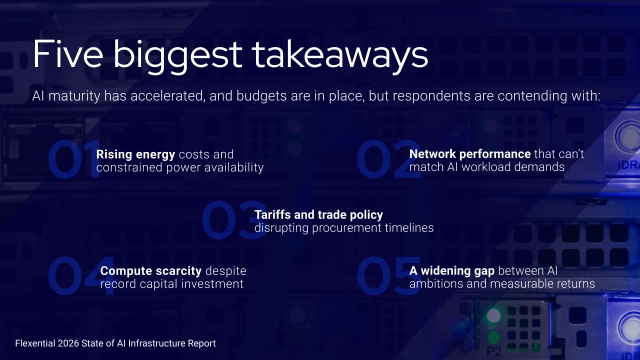
AI ambitions are accelerating. Infrastructure limitations are accelerating faster. Power constraints, network bottlenecks, compute scarcity, and rising costs are reshaping how enterprises scale AI.
In our third annual survey of 350+ enterprise IT leaders, organizations report growing confidence in AI adoption, but mounting pressure on the infrastructure required to support it. Last year’s State of AI Infrastructure Report revealed growing AI momentum and executive investment. This year’s findings show the conversation has shifted toward the infrastructure realities required to scale AI successfully.
As organizations push AI strategies forward, infrastructure readiness is becoming the defining factor separating ambition from execution.
AI momentum continues—but infrastructure pressures are intensifying:
- Power availability now influences where AI workloads can realistically run
- Network latency and fiber shortages are disrupting AI performance at scale
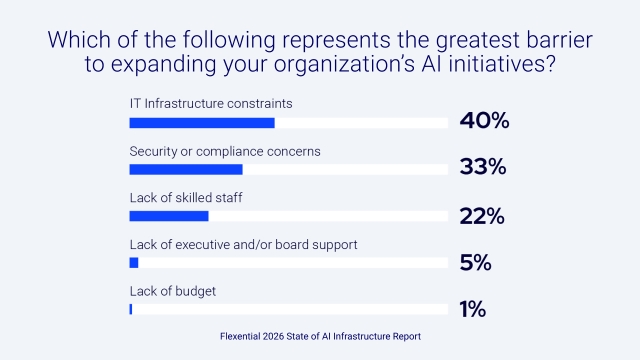
- Infrastructure constraints now outweigh budget concerns for AI expansion
- AI compute and enterprise data are increasingly separated across environments
- Organizations are reevaluating AI ROI timelines as infrastructure costs rise
Key findings
- 55% rank power cost or pricing differences as the top factor influencing where AI workloads are deployed.
- 96% experienced at least one network-related performance issue affecting AI workloads over the past 12 months.
- 91% say fiber availability, along with carrier diversity and low-latency connectivity, have limited AI deployment site selection.
- 55% now measure AI success through cost reduction and operational efficiency, overtaking revenue growth.
- The share expecting measurable AI financial returns within one year dropped from 51% to 36%.
- 54% say tariffs increased reliance on domestic suppliers, while 40% delayed or scaled back purchasing.
- AI compute and AI data are moving in opposite directions, with GPU deployments shifting toward the public cloud while enterprise data moves away from it.
- 98% view nuclear power as a viable energy source for AI infrastructure within five to 10 years.
Power
Power has become the defining constraint on AI growth
AI infrastructure is no longer just a technology conversation: it’s increasingly an energy conversation. As enterprise AI deployments grow larger and more compute-intensive, organizations are reevaluating how power availability, electricity pricing, and geographic flexibility influence long-term infrastructure strategy.
89% say reliable grid power influences AI deployment decisions, while 55% rank power cost differences as the top factor influencing AI workload location.
{{statOne}}
Energy strategy is becoming AI strategy
As AI environments scale, organizations are placing greater emphasis on operational efficiency, sustainability, and long-term power availability. Rising energy costs and increasing infrastructure density are forcing enterprises to rethink where and how AI workloads can operate efficiently over time.
72% are concerned about electricity price volatility affecting AI operating costs, while 67% believe renewables will play the largest role in supporting AI workloads within five years.
{{statTwo}}
Get an Infrastructure Reality Check
Constraints converge
Infrastructure constraints are converging across the AI stack
AI adoption is accelerating, but infrastructure limitations are becoming harder to ignore.
Organizations are navigating compute shortages, deployment delays, workforce challenges, procurement uncertainty, and growing operational complexity as AI workloads scale across the enterprise.
The report reveals how multiple infrastructure pressures are beginning to converge simultaneously, forcing organizations to adapt AI strategies around available capacity, operational realities, and deployment flexibility.
{{statBigOne}}
Infrastructure constraints now outweigh budget concerns
The challenge for most enterprises is no longer whether they can invest in AI; it’s whether infrastructure can support AI initiatives at the pace organizations expect.
Networking constraints
AI’s hidden infrastructure challenge is networking
As GPU deployments shift toward the public cloud and enterprise data moves into hybrid and colocation environments, networking performance is becoming critical to AI scalability. Organizations are increasingly reevaluating how connectivity, proximity, and workload placement affect AI application performance.
96% experienced network-related AI performance issues over the past 12 months, including latency, bandwidth shortages, and unreliable connectivity.
{{statThree}}
Connectivity readiness now influences AI deployment strategy
Fiber availability, carrier diversity, and low-latency interconnection are increasingly shaping where organizations can successfully deploy AI workloads. As AI environments become more distributed, networking infrastructure is becoming a major operational consideration.
71% experienced excessive latency affecting AI workloads, while 54% say fiber availability delayed AI deployments.
Organizations are increasingly reevaluating how proximity, interconnection, and workload placement affect AI application performance.
{{statFour}}
Discover the Power of Ecosystems
Tariffs and policy uncertainty
AI infrastructure planning is becoming harder to predict
Tariffs, supply chain instability, and policy uncertainty are creating new operational risks for enterprise AI infrastructure planning. Organizations are adjusting procurement strategies, reevaluating vendors, and adapting deployment timelines as infrastructure costs continue to evolve.
54% increased reliance on domestic suppliers, while 40% delayed or scaled back AI infrastructure purchases.
Enterprises are also adapting strategies in an attempt to balance infrastructure flexibility with longer-term purchasing strategies and reduce operational uncertainty.
{{statBigTwo}}
Policy and procurement pressures are reshaping AI strategy
AI regulations and market conditions continue to shift, and organizations are reevaluating how infrastructure strategies align with long-term operational requirements, cost management, and deployment flexibility.
94% say regulatory and policy uncertainty affects AI infrastructure planning, with 35% describing the impact as significant.
ROI and budgets
AI investment remains strong, but expectations are evolving
Organizations remain committed to AI, but expectations around financial return timelines are becoming more measured as infrastructure costs and deployment complexity continue to grow. Enterprises are increasingly evaluating AI success through operational efficiency, scalability, and long-term business value.
The share expecting measurable AI financial returns within one year dropped from 51% to 36%, while the share already seeing returns remained flat at 20%.
{{statBigThree}}
Organizations are redefining how AI success is measured
As AI adoption expands across the enterprise, organizations are shifting focus from rapid revenue generation toward operational improvements, cost reduction, and sustainable infrastructure growth. AI investment priorities continue expanding across networking, compute, and infrastructure environments.
55% now measure AI success through cost reduction and operational efficiency, while 70% are allocating at least 10% of IT budgets toward AI initiatives.
Conclusion
Build infrastructure that’s ready for what’s next
AI is reshaping how organizations operate, but scaling successfully now depends on more than AI adoption alone. As power constraints, networking limitations, compute availability, and operational complexity continue to grow, enterprises must rethink how infrastructure supports long-term AI performance and scalability.
Working with an experienced infrastructure provider can help organizations navigate evolving AI demands while supporting long-term business growth and resilience.
Click below to download this resource!