

Connectivity is now the strategic layer of ecosystem-driven IT
Hybrid environments, AI workloads, and partner-heavy architectures are changing what enterprise IT needs from its network. Learn how to design for it and watch the full FlexTalk webinar on demand.

Traditional IT was built around one assumption: run everything on internal systems. ERP, sales tools, corporate networking, all of it lived inside the four walls or in a data center you operated yourself.
That model is flipping. Enterprises are moving to ecosystem-driven IT, where the question is how to connect out safely, quickly, and at scale to clouds, SaaS platforms, AI providers, and partners.
A useful way to think about it: we used to collect DVDs to watch our favorite shows. Now we open Netflix and everything's there. You don't have to hold every piece of infrastructure yourself.
That same shift is happening across enterprise IT, and it's changing how teams think about speed, cost, performance, and design.
Connectivity is the constraint nobody planned for
Most teams already understand the move to cloud, SaaS, and AI. The harder problem is connecting to all of it reliably, at high capacity, across multiple regions.
"People understand something has to move to AWS. They're not necessarily leading with, OK, but how do we connect to it reliably at high capacity for multiple regions."
This is the space interconnection fabrics and marketplaces fill. Instead of waiting months for a carrier circuit, teams can spin up a private or internet link in minutes on a single multi-service port. Same physical port, different traffic, different providers, all on demand.
The model shifts from circuit-first to workload-first: architect for the application, then toggle connectivity as required.
Speed and flexibility have become table stakes
The 36-month, fixed-capacity circuit doesn't fit how modern workloads behave. AI training, data ingestion, seasonal peaks, all of it is volatile.
"Talk to anyone who works in AI and ask them how much compute they're going to need in six months and they're going to have no idea."
Connectivity is following cloud consumption principles with hourly or monthly terms, elastic bandwidth, and usage-based egress. Teams can burst to 100G for ingestion, scale back for inference, and reallocate capacity across providers without contractual friction.
The Flexential team shared a recent customer story that captured the change. The customer needed internet service stood up the morning their deployment began. They selected a fabric port, configured the throughput they wanted, and within minutes their network was ready to go.
Place the workload where it performs. Place the network close to your users.
Designing for multi-cloud and AI comes down to two questions: where does the workload run, and where are the users?
Some workloads belong in public cloud. Others fit better in private cloud or colocation because of data gravity, compliance, or proximity to specialized compute. User location drives latency, and users grade IT teams on whether services are available and performance is there.
A distributed edge approach pairs placement with proximity. Interconnection fabrics give you dense, regional access to clouds, carriers, and partners, shortening paths and simplifying multi-region growth.
Path selection follows. Compliance and data gravity often favor private transport, which also limits exposure and can reduce egress fees. Budget-constrained designs can phase in resilience, such as one private circuit with an encrypted VPN over the internet as backup.
AI is rewriting the network requirements
AI workloads are moving 100G handoffs from a stretch goal to common practice. They're also reshaping the physical plant inside data centers.
"We're just having to put in enormous amounts of high-density fiber in these facilities."
As AI deployments grow across data halls and even multiple buildings on a single campus, fiber count, conduit capacity, and meet-me room density all have to grow with them. Some training and inference workloads need dark fiber adjacency measured in tens of meters.
East-west capacity matters as much as ingress. Teams are bringing in large datasets, replicating across nodes, and returning model outputs to customer environments. Software-defined provisioning on a single high-capacity port lets you segment that traffic cleanly, with virtual circuits for public-facing traffic, private point-to-point, and storage marketplace connectivity all running over the same port.
The hardware decisions that won't age out
One of the more practical takeaways from the session was about edge equipment. Two shifts to plan for.
First, copper-based handoffs are being phased out across the colocation industry. Even US telecom regulatory bodies are signaling they won't support copper long-term. The future is fiber.
Second, the SFP form factor that supported 1, 10, and 25G is giving way to QSFP as enterprises move to 100G and 400G. The two don't fit the same slot, so hardware planned for one won't accept the other.
If you're refreshing edge equipment in the next 12 to 24 months, plan for both.
Watch the on-demand webinar
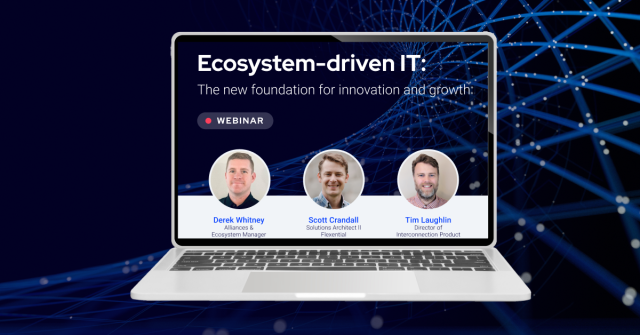
If you're rethinking how your connectivity strategy supports hybrid cloud, AI, and partner ecosystems, this on-demand FlexTalk goes deeper into the design choices that matter most right now.
Watch the on-demand webinar: Ecosystem-driven IT: The new foundation for innovation and growth
In this FlexTalk session, Flexential experts share practical insight on:
- How interconnection reduces complexity across hybrid, multi-cloud environments
- Why ecosystem-driven strategies improve performance and agility
- How to deliver better customer experiences through seamless connectivity
- How the Flexential Marketplace enables fast, secure access to a rich ecosystem of partners
- What AI workloads demand from connectivity, fiber density, and edge hardware
Turn your digital ecosystem into a competitive advantage.
"You have the network on demand available, how you need it, when you need it."