


Is your VMware renewal arriving before your strategy is ready?
For years, VMware renewals were largely operational exercises. Organizations reviewed their environments, renewed licensing, and moved forward with business as usual. Today, they're strategic inflection points.

Broadcom's changes to VMware licensing, packaging, and partner programs have prompted organizations to reevaluate not only their VMware investments, but their broader infrastructure strategy. At the same time, modernization initiatives, evolving cloud strategies, rising costs, and growing business demands are forcing IT leaders to answer bigger questions about where workloads should live in the future.
The challenge is that renewal timelines often arrive before those strategic decisions have been made.
When renewal timelines outpace infrastructure planning
A VMware renewal is often the first deadline that forces organizations to confront broader questions they've already been considering.
Should critical workloads remain where they are today? Which applications are candidates for modernization? Is public cloud, hosted private cloud, or a hybrid approach the right long-term fit? What role should VMware Cloud Foundation (VCF) play going forward?
These are infrastructure strategy questions—not simply licensing questions.
They require assessment, planning, stakeholder alignment, and a clear understanding of application dependencies, business priorities, and future technology goals.
Yet many organizations find themselves facing renewal deadlines before that work is complete.
The questions IT leaders are trying to answer
While every environment is different, the conversations sound remarkably similar.
Strategic planning
- What should our infrastructure look like over the next three to five years?
- Should VMware continue to be part of our long-term strategy?
- Is VMware Cloud Foundation the right platform for where we're headed?
Workload placement
- Which applications belong in hosted private cloud, public cloud, or on-premises infrastructure?
- Which workloads should move first—and which should stay where they are?
Operational readiness
- How do we modernize without disrupting production environments?
- How should disaster recovery and resiliency influence infrastructure decisions?
- How do we avoid making a long-term technology decision simply because a renewal date is approaching?
There are no universal answers. Every organization has different business priorities, technical requirements, compliance considerations, and operational constraints.
What is universal is that answering these questions takes time.
The risk of making long-term decisions on short-term timelines
When renewal pressure increases, organizations often feel forced into one of two paths.
They either commit to a long-term licensing decision before their infrastructure strategy is fully defined, or they accelerate migration and modernization initiatives before the organization is operationally ready.
Neither approach is ideal.
Infrastructure decisions made under deadline pressure can increase costs, introduce unnecessary risk, and limit future flexibility. More importantly, they can shift attention away from developing a thoughtful roadmap that aligns technology investments with long-term business objectives.
A renewal deadline shouldn't dictate the future of your infrastructure.
Creating time for better decisions
For many organizations, the right answer isn't delaying planning or rushing into a decision—it's creating enough flexibility to complete that planning well.
Separating renewal timing from strategic timing allows IT teams to evaluate options, engage stakeholders, and build a roadmap without unnecessary pressure.
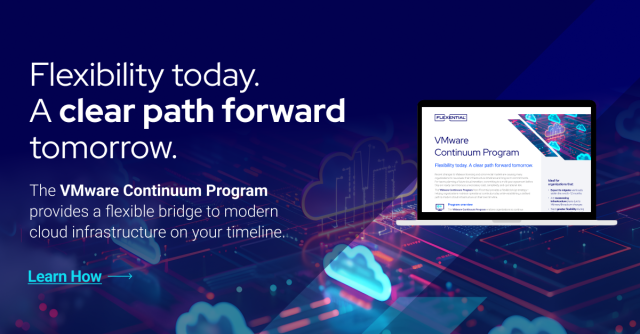
That's why Flexential developed the VMware Continuum Program.
The VMware Continuum Program provides short-term VMware bridge licensing that helps organizations maintain operational continuity while evaluating their long-term infrastructure strategy. Rather than forcing a permanent licensing decision before planning is complete, organizations gain the flexibility to move forward at the pace that makes sense for their business.
With the VMware Continuum Program, organizations can:
- Extend VMware licensing while strategic planning continues
- Maintain operational continuity without unnecessary disruption
- Reduce pressure created by renewal deadlines
- Evaluate modernization and cloud options with greater confidence
- Transition to Flexential cloud when the timing aligns with business objectives
Instead of rushing into a decision, IT teams gain something increasingly valuable during a renewal cycle: time.
Start with a cloud assessment
Before deciding whether to renew, modernize, migrate, or adopt VMware Cloud Foundation, it's important to understand your current environment.
That's why many VMware conversations with Flexential begin with a cloud assessment.
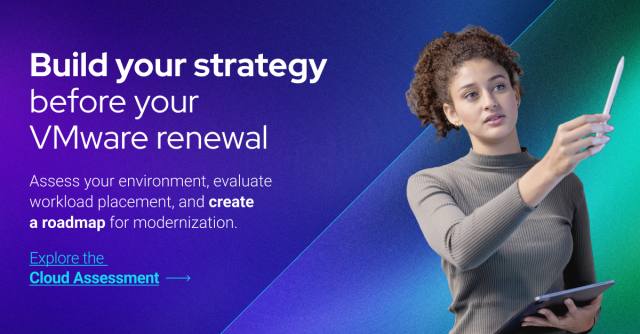
A Flexential Cloud Assessment helps organizations evaluate:
- Current VMware infrastructure and licensing considerations
- Application dependencies and business requirements
- Workload placement opportunities across hybrid environments
- Disaster recovery and resiliency requirements
- Cloud migration readiness
- Infrastructure modernization priorities
The outcome isn't simply a recommendation—it's a roadmap.
Rather than answering only, "What should we renew?", organizations gain the visibility to answer much larger questions:
- Which workloads belong where?
- Which applications should move first?
- What should the modernization roadmap look like?
- How should future infrastructure investments be prioritized?
Those answers create a strategy that extends well beyond the next renewal date.
Build your strategy before your timeline forces the decision
VMware renewal timelines will continue to arrive on schedule. Your infrastructure strategy shouldn't have to.
Whether your next step is renewing, modernizing, adopting VMware Cloud Foundation, or evaluating cloud alternatives, the best decisions are made with a clear understanding of your environment—not under the pressure of an impending deadline.
The Flexential VMware Continuum Program and Cloud Assessment help organizations create the time and clarity needed to make infrastructure decisions that support both today's operations and tomorrow's business goals.

Kim Pike
Product Marketing Director