


How market uncertainty is reshaping AI infrastructure investment
As market uncertainty complicates AI infrastructure investments, enterprises are rethinking how they access capacity, manage costs and maintain the flexibility to grow.

Enterprise infrastructure planning has traditionally relied on a degree of predictability. Hardware refresh cycles, capital budgets, procurement timelines and capacity forecasts have provided a foundation for multiyear technology investments. While demand has never been entirely predictable, organizations could generally build their infrastructure roadmaps around reasonably stable assumptions about cost and availability.
Those assumptions are becoming harder to rely on. Evolving trade policies, tariffs, supply chain instability and competition for advanced computing resources are introducing new variables into infrastructure decisions, particularly as enterprises invest in the capacity required to support AI.
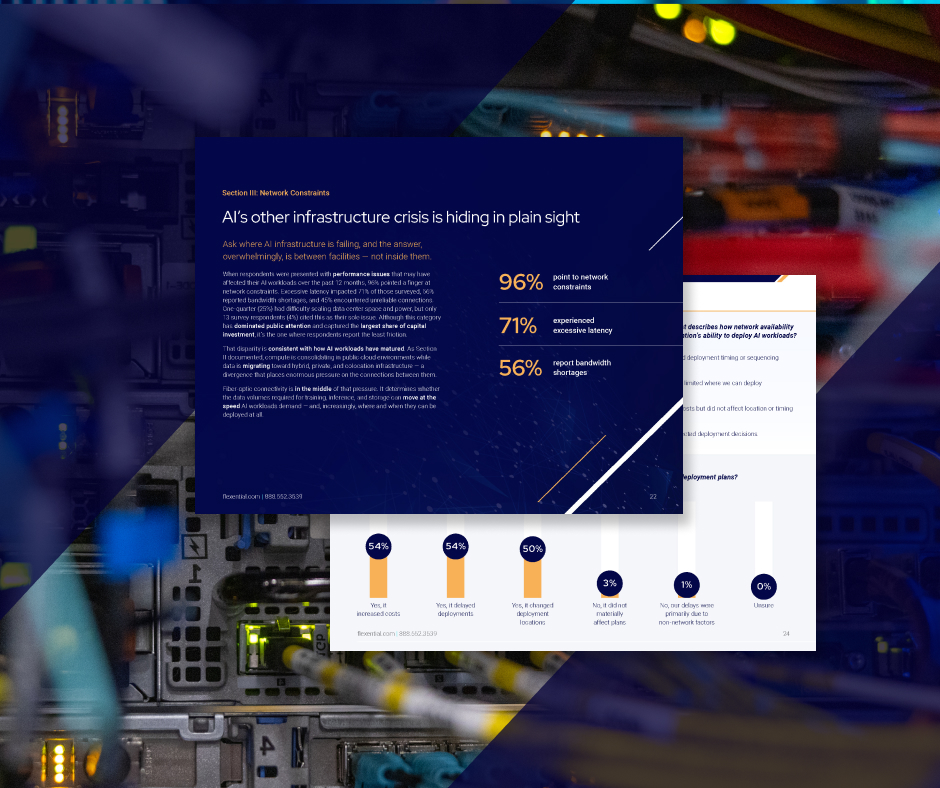
In the Flexential State of AI Infrastructure Report, 54% of surveyed enterprise IT leaders reported increasing their reliance on domestic suppliers in response to tariffs, while 40% delayed or scaled back AI infrastructure purchases.
These findings point to a challenge that extends beyond procurement. When the cost, availability and delivery of hardware become less predictable, the infrastructure strategies that depend on them become more vulnerable.
The question is no longer simply how to purchase infrastructure more effectively. It is how to maintain business momentum when the conditions surrounding those investments continue to change.
How tariffs and policy uncertainty affect enterprise IT infrastructure
The immediate concern surrounding tariffs is often the potential for higher hardware costs. Enterprise infrastructure relies on globally distributed supply chains for servers, storage, networking equipment, semiconductors and other critical components. Even equipment purchased through domestic suppliers may depend on internationally sourced materials and components, limiting the extent to which changing vendors can reduce exposure.
However, uncertainty itself can be just as consequential as higher prices. When organizations cannot confidently forecast what infrastructure will cost or when it will be available, decisions about technology refreshes, modernization initiatives and capacity expansion become more complicated.
An enterprise might delay a planned hardware purchase while waiting for greater pricing stability, only to find that existing infrastructure cannot support growing application demand. Another might accelerate procurement to avoid potential price increases, committing capital to capacity that may not be fully utilized for months or years.
Both responses can be understandable, but neither necessarily addresses the underlying risk: the organization's ability to execute its business strategy remains tied to hardware procurement conditions outside its control.
AI investment is exposing the limitations of traditional infrastructure planning
AI is making this challenge particularly visible. Unlike established enterprise workloads with more predictable resource requirements, emerging AI applications can introduce significant uncertainty around compute demand, deployment timelines and infrastructure utilization.
An organization may know that it needs to invest in AI without knowing precisely how its requirements will evolve as applications move from experimentation into production. New hardware generations, changing model architectures and different approaches to training and inference can further complicate decisions about what capacity to purchase and when.
These considerations extend beyond compute. GPU-intensive deployments can require higher power densities, advanced cooling and greater network capacity, meaning a hardware investment may trigger additional infrastructure requirements that were not part of the original business case.
Committing too early can lock organizations into infrastructure that no longer aligns with their needs. Waiting too long can delay initiatives that are strategically important to the business.
The challenge is finding an infrastructure model that accommodates both the pace of AI innovation and the uncertainty surrounding the resources required to support it.
STATE OF AI INFRASTRUCTURE REPORT
Market uncertainty is reshaping AI investment
40% of surveyed enterprise IT leaders delayed or scaled back AI infrastructure purchases in response to tariffs. Discover how changing market conditions and infrastructure constraints are influencing enterprise AI strategies.
The hidden cost of waiting for certainty
Delaying infrastructure investments may appear to be the conservative response to an unpredictable market. In some circumstances, it is the right decision. Not every refresh or expansion needs to happen immediately, and extending the useful life of existing assets can be financially sound.
But postponing an investment does not necessarily postpone the need for it. Applications continue to grow, data volumes increase, equipment ages and business requirements evolve regardless of what happens in the hardware market.
Over time, delayed investments can contribute to capacity limitations, performance issues, mounting technical debt and greater pressure on IT teams maintaining aging environments. Organizations may also find themselves making urgent infrastructure decisions later, when they have fewer options and less time to evaluate them.
For business leaders, that changes how infrastructure risk should be assessed. The potential cost of purchasing at the wrong time needs to be weighed against the operational and competitive cost of not having capacity when the business needs it.
The cost of waiting belongs in the infrastructure business case.
Why infrastructure flexibility matters in a volatile hardware market
Traditional infrastructure planning often assumes that capacity must be purchased and deployed ahead of demand. While this approach remains appropriate for many predictable, long-term workloads, it can create challenges when future requirements and procurement conditions are difficult to forecast.
Modern infrastructure strategies offer additional ways to balance control, cost and flexibility. Rather than relying entirely on owned infrastructure or shifting every workload to the cloud, enterprises can evaluate combinations of infrastructure models that align with different business and application requirements.
Balancing ownership with access to capacity
Infrastructure ownership can provide greater control over hardware configuration, performance and certain long-term cost structures. Accessing capacity through cloud or managed infrastructure services, meanwhile, can reduce the need for enterprises to directly procure and maintain hardware for every workload.
Explore why overprovisioning is becoming unsustainable and how capacity on demand models help businesses stay prepared for growth, recovery, and change, in our ebook, Stop building for peak.
The advantage is not simply shifting capital expenditure to operational expenditure. It is creating more options for when and how infrastructure investments are made, allowing organizations to align commitments more closely with actual business demand.
Service providers remain exposed to hardware market conditions, but their infrastructure consumption models can help enterprises reduce their direct exposure to individual procurement cycles.
Separating facility investments from hardware decisions
Organizations that require dedicated hardware do not necessarily need to own and operate the facilities supporting it. Colocation allows enterprises to retain control over their equipment while accessing third-party data center infrastructure, including power, cooling and connectivity.
This separation can become particularly valuable as hardware generations introduce new infrastructure requirements. Instead of making simultaneous investments in compute and facility modernization, organizations can evaluate environments that support their current configurations while providing room for future expansion.
It does not eliminate hardware procurement risk, but it can reduce the number of infrastructure investments an enterprise must coordinate independently.
Preserving options through hybrid IT
A hybrid IT strategy can provide additional flexibility by allowing organizations to distribute workloads across owned infrastructure, colocation, private cloud and public cloud environments according to their requirements.
Predictable workloads may remain on dedicated infrastructure, while applications with evolving resource demands may benefit from more flexible consumption models. Specialized AI capabilities can be accessed through external providers where appropriate, rather than requiring the enterprise to invest immediately in every component of the underlying infrastructure.
The value of this approach depends on how effectively those environments operate together. Connectivity, security, governance and data mobility become increasingly important as infrastructure decisions extend beyond a single location or platform.
Infrastructure predictability is about more than price
As enterprises respond to hardware volatility, predictability should remain a priority. But predictable infrastructure spending does not necessarily mean securing the lowest hardware price or locking in every technology investment years in advance.
It can also mean having greater confidence that capacity will be available when needed, that investments can scale alongside demand and that deployment timelines are less dependent on any single procurement decision.
This broader definition of predictability connects infrastructure planning more directly to business outcomes. Instead of evaluating infrastructure models solely on acquisition cost, organizations can consider how different approaches affect time to deployment, capital efficiency, operational requirements and the ability to respond to changing business priorities.
As explored in the Flexential ebook, Rethinking infrastructure in a volatile hardware market, flexibility is increasingly becoming a strategic advantage for enterprises looking to maintain scalability without being constrained by traditional procurement cycles.
Plan for uncertainty rather than around it
Tariffs, trade policies and hardware market conditions will continue to evolve. Enterprises cannot remove every external variable from their infrastructure strategies, but they can evaluate how much their ability to grow depends on those variables.
That requires looking beyond individual hardware purchases to consider how infrastructure is accessed, where workloads operate, how capacity scales and which investments need to be made directly by the organization.
Through the FlexAnywhere® Platform, Flexential brings together colocation, cloud, interconnection, data protection and professional services to help enterprises develop infrastructure strategies that balance control, performance, predictability and flexibility.
For organizations navigating uncertain hardware markets, the objective is not to predict every market shift. It is to build an infrastructure strategy that can accommodate change without making business progress dependent on it.
Tariffs and policy uncertainty are just part of a larger shift in enterprise AI infrastructure planning. Explore how IT leaders are responding to changing market conditions, infrastructure constraints and evolving investment priorities in the State of AI Infrastructure Report or talk with a Flexential infrastructure expert about building flexibility into your infrastructure strategy.