
The backup tier that survives when an entire region goes offline
A recent FlexTalk webinar with Lonestar Data Holdings asks a hard question: where should your most critical data live when a whole region can vanish at once? Watch the full session on demand.
When drone strikes hit AWS data centers in the Gulf, two of the UAE region's three availability zones went offline. Banks, payment platforms, and delivery apps across the region felt it within hours.
For years the industry has talked about "the cloud" as if it were weightless and out of reach. This year was a reminder that clouds run on physical buildings, and a building can be found on a map and struck.
For anyone whose job is to plan for the worst day, that opened up an uncomfortable scenario: a disaster that reaches an entire region at once, along with the recovery site you were counting on.
This scenario sits at the center of a recent FlexTalk webinar, where Flexential and Lonestar Data Holdings walked through a recovery tier that lives off the grid in the most literal sense: encrypted, immutable backups stored in space.
"Think of it like Starlink, but for data and disaster recovery."
When a whole region can go dark
Most disaster recovery plans assume distance solves the problem. Keep production in one place, keep a copy a few hundred miles away, and a local outage won't touch both. That model was built for contained, local trouble, and the events of this year stretched well past it. A coordinated attack, a widespread grid failure, or a geopolitical conflict rarely respects a clean 500-mile radius, and multi-region designs often share cloud control planes, backbone routes, and power markets that one event can reach at once.
Ransomware made it worse by changing its target. Attackers learned that the fastest way to force a payout is to go after the recovery path itself: backup repositories, replication targets, and the consoles that manage them. Many teams only discover mid-incident that their "isolated" backup shared the same identity system, admins, and network as production. Then the hard part becomes proving which copy is clean while the clock runs.
A backup tier that lives off the grid
Space-based storage answers that with separation. Chris Stott, Lonestar's founder and CEO, described it in plain terms during the session: an external hard drive that happens to sit in space, powered by the sun, naturally cooled, holding an immutable copy of the data you cannot afford to lose.
The security value comes down to what an attacker can physically reach. On the ground, a well-run backup is air-gapped inside a locked rack. In orbit, it's vacuum-gapped. You cannot walk up to a satellite, the connection only opens when you ask it to, and the customer holds the encryption keys. What you get is a clean reference copy that holds up even when everything connected on Earth is in question.
"It's an application of rocket science to data science."
Flexential supplies the hybrid layer that makes this workable. Michael Fitzgerald, Senior Director of Engineering, pointed to the company's 40 data centers across 18 markets, a 400-gig backbone, and more than 300 carrier connections as the ground infrastructure already delivering geographic and network diversity. Extending that reach into low Earth orbit adds an independent layer that survives when the infrastructure underneath it fails. Lonestar is scaling toward it fast, with missions that climb from hundreds of terabytes today toward exabyte capacity by 2030.
Solving the sovereignty problem with space law
Distance solves one problem and creates another. Many jurisdictions require certain data to stay inside national borders, which limits where you can place a backup or run a recovery. Stott counted 141 countries with data sovereignty rules on the books. In a wide regional outage, the safest technical place to recover might sit outside the boundary you're legally allowed to use, forcing a choice between staying compliant and staying online.
Space law offers a way through. Under the Outer Space Treaty and the decades of practice built on it, an object launched into orbit stays under the jurisdiction of the country that registered it. Lonestar applies a technique satellite operators have used for years, the hosted payload, to create what the industry now calls a "data embassy": a controlled compartment that operates off-planet while remaining, in legal terms, an extension of a specific country.
"You can be off the planet but still legally in country."
Estonia proved the ground version back in 2017, backing up its government to sovereign territory inside its embassy in Luxembourg. Putting that compartment in orbit keeps the legal footing and drops the physical risk.
Where this fits in a real recovery plan
Space storage earns its place as a hardened tier for the handful of datasets that absolutely have to survive: government and archival records, financial and regulatory data, source code and AI models, healthcare research, and defense information. The speakers framed it as a complement to everyday systems, reserved for the critical few. The practical starting point is to identify that "must-survive" data, find where a catastrophic loss could still reach every existing copy, and weigh the cost of protection against the cost of losing it outright.
The economics are more ordinary than you'd expect. Stott put near-term storage at roughly $1,400 per terabyte per year at a fixed, predictable price, with early missions targeting recovery windows measured in hours and improving as the constellation grows. Newer satellites even carry GPUs, so an organization can run private, encrypted inference against its own data in orbit, keeping a vault it can actually query when terrestrial systems are down.
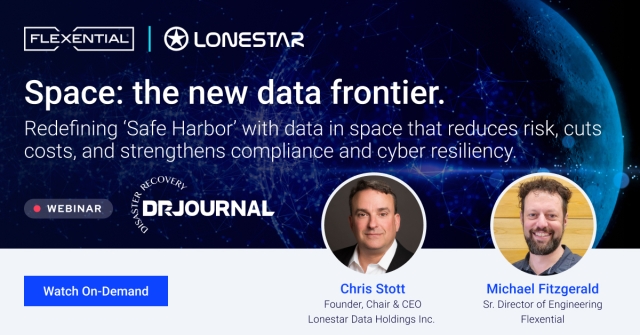
Watch the on-demand webinar
Space: The new data frontier brings Flexential and Lonestar together for a practical look at where off-planet storage fits in a modern resilience strategy.
In this FlexTalk session, you'll learn:
- Why regional outages and coordinated attacks are straining traditional geodiversity
- How vacuum-gapped, immutable storage protects backups from ransomware
- How space law keeps off-planet data compliant with residency requirements
- What current missions cost, and the recovery performance to expect today
- Which datasets belong in an orbital tier, and how to start evaluating one
The worst day may still be years away, or it may look a lot like this spring. Either way, the backup you'll want is the one sitting where no attacker, storm, or grid failure on Earth can reach it.
"We've just put it somewhere safer than the Earth by putting it in space."