

Agentic AI is changing what infrastructure readiness means
As AI agents take on more responsibility across enterprise systems, infrastructure leaders face new questions about operational control, security and recovery.

IT teams have relied on automation for years. Scripts restart services, orchestration platforms provision resources, and monitoring tools trigger responses when performance falls outside established thresholds. These processes help organizations manage increasingly complex environments without requiring manual intervention for every task. Agentic AI introduces a different level of autonomy, allowing systems to interpret objectives, evaluate information, select tools and initiate actions across production applications, infrastructure resources and interconnected systems.
For IT teams managing distributed environments with limited resources, that flexibility offers significant potential to improve efficiency and responsiveness. It also introduces operational risks that organizations are only beginning to understand, particularly when agents are authorized to make changes without direct human approval.
Recent Gartner research highlights the concern. In a November 2026 survey of infrastructure and operations (I&O) leaders, 95% reported experiencing at least one agent-related incident during the preceding year. Gartner also predicts that inadequate governance could contribute to business-critical disruptions for 40% of I&O organizations scaling AI by 2028. The findings raise a practical issue for enterprise technology leaders: as AI agents become part of daily operations, organizations need to understand how their infrastructure, security practices and operating models will accommodate systems capable of acting independently.
When automation becomes autonomous
Traditional automation is generally predictable. A predefined condition triggers a specific action, with the process operating within established parameters. AI agents have more flexibility in how they complete a task. An agent assigned to investigate an application performance problem, for example, might examine monitoring data, identify a potential resource constraint and determine that additional capacity is needed. With the appropriate permissions, it could initiate that change without waiting for an administrator.
In many situations, that speed could be valuable. The complication arises when an agent's assessment is incomplete or its actions have consequences beyond the immediate task. Increasing compute resources might address one performance issue while creating unexpected costs or affecting shared infrastructure. A configuration change intended to resolve a service problem could disrupt another application that depends on the same environment.
These scenarios are not unique to AI. Human administrators and conventional automation can make similar mistakes. The difference is that autonomous agents may execute a series of decisions across multiple systems before a person reviews the outcome. As organizations expand the responsibilities assigned to AI agents, they also expand the potential consequences of incorrect decisions, excessive permissions and poorly understood dependencies.
Operational readiness starts with knowing what's running
One of the first challenges is visibility. Many organizations already struggle to maintain a complete picture of applications, infrastructure dependencies and data flows across hybrid environments. AI agents add another layer of activity that IT teams need to understand. An agent may interact with cloud services, internal applications, data repositories and management tools. Some agents may be deployed directly by IT, while others arrive through AI capabilities embedded in existing business applications.
Without a clear inventory, organizations may not know which agents are active, what information they can access or which operational changes they are authorized to make. That visibility needs to extend beyond traditional infrastructure monitoring. CPU utilization, network performance and application availability remain important, but they cannot explain why an agent selected a particular action or which systems it affected.
Operational teams need access to records of agent activity, tool usage, permissions and resulting changes. These records should be available alongside the infrastructure and application telemetry used to investigate performance issues and service disruptions. For organizations running AI across multiple environments, maintaining that visibility consistently becomes an important operational requirement.
Security controls need to account for how agents behave
AI agents introduce security considerations that extend beyond conventional application access. An agent may require legitimate access to sensitive information or administrative tools to complete its assigned work. Those permissions can become a liability if the agent behaves unexpectedly, receives malicious instructions or interacts with compromised data.
Prompt injection is one example. An attacker may attempt to influence an agent's behavior through content it processes, potentially causing it to disclose information or perform actions outside its intended purpose. Other risks include data or model poisoning, insecure integrations and excessive access privileges.
Existing cybersecurity practices remain essential, particularly identity management, access controls, configuration hardening and vulnerability management. A broader AI governance framework also helps establish the policies, accountability and oversight needed to manage these risks.
However, organizations also need to evaluate whether those controls adequately address AI-specific threats. Independent security validation can help expose weaknesses before they affect production operations. Testing should consider how an AI system responds to adversarial inputs, whether its permissions are appropriately restricted and how effectively security controls prevent unintended actions.
This is especially important when an agent can interact with infrastructure management tools or systems containing sensitive business data. The goal is to give agents sufficient access to perform useful work without granting authority that exceeds their operational responsibilities.
Recovery planning must account for unintended actions
Infrastructure resilience is another area where agentic AI changes the conversation. Traditional disaster recovery planning often focuses on events such as hardware failures, network outages, cyberattacks and application disruptions. Organizations establish recovery objectives, maintain backup and recovery capabilities, and test their ability to restore critical systems.
Those practices remain necessary, but an AI-related incident may not begin with a failed component or an unavailable application. An agent could modify a configuration, change resource allocations or initiate a sequence of actions that affects multiple systems. The underlying infrastructure might remain available even as applications behave incorrectly or business processes become disrupted. Responding effectively requires more than restoring a server or restarting a service.
IT teams need procedures for identifying the responsible agent, suspending its activity, reviewing the changes it made and determining which systems were affected. They also need a reliable way to reverse inappropriate changes or recover affected services. In distributed environments, these procedures may involve multiple infrastructure platforms, application owners, security teams and service providers. Testing becomes particularly important, as organizations should validate whether they can contain an agent-related incident and restore normal operations without introducing additional disruption.
Recovery readiness needs to reflect how AI systems operate in production, including the dependencies and automated actions that can affect service availability.
Five operational questions to address before scaling AI agents
As organizations move from experimentation to production, infrastructure and security leaders should evaluate several practical considerations.
1. Who owns each AI agent and its actions?
Establish clear accountability for agent deployment, configuration, permissions and ongoing management. Ownership should extend across the application, infrastructure, security and data teams involved in supporting the agent.
2. Do we have visibility into agent activity and infrastructure dependencies?
Maintain an inventory of agents, connected systems and data flows. Confirm that monitoring and logging can connect agent actions with changes in application behavior, resource utilization and infrastructure performance.
3. Are permissions appropriate for the work agents perform?
Apply least-privilege principles and establish approval requirements for higher-risk activities. Agents that analyze information may require different controls from those authorized to change production configurations or security settings.
4. Have we tested how agents respond to unexpected conditions or malicious inputs?
Evaluate AI-specific security risks, including prompt injection and data poisoning. Validate operational safeguards, access restrictions and escalation procedures before expanding an agent's responsibilities.
5. Can we contain an incident and recover affected services?
Define procedures for stopping agent activity, revoking access, identifying unintended changes and restoring normal operations. Include agent-related scenarios in incident response and recovery testing.
These questions provide a starting point for assessing whether existing operational practices can support the level of autonomy an organization intends to introduce.
Production AI requires ongoing operational discipline
Many organizations approach AI adoption as a progression from experimentation to deployment. Once a model or application performs as expected, attention shifts toward scaling adoption and demonstrating business value. Production operations require a broader view.
AI environments depend on interconnected infrastructure, data pipelines, model hosting, network services and security controls. As agents interact with these components, organizations need established processes for monitoring, maintaining and validating the environment over time. That includes routine security hygiene, configuration management, performance monitoring, incident response and recovery testing. It also requires clear responsibilities across the teams managing infrastructure, applications, data and cybersecurity.
These are established IT disciplines, but their application becomes more complex as AI systems gain autonomy. The challenge is particularly relevant in hybrid environments, where AI workloads and supporting services may operate across multiple infrastructure platforms. As organizations rethink their IT infrastructure for AI, they must also consider how operating models, team responsibilities and management practices support increasingly autonomous workloads. Different management tools, security policies and operational responsibilities can make it harder to maintain consistent oversight.
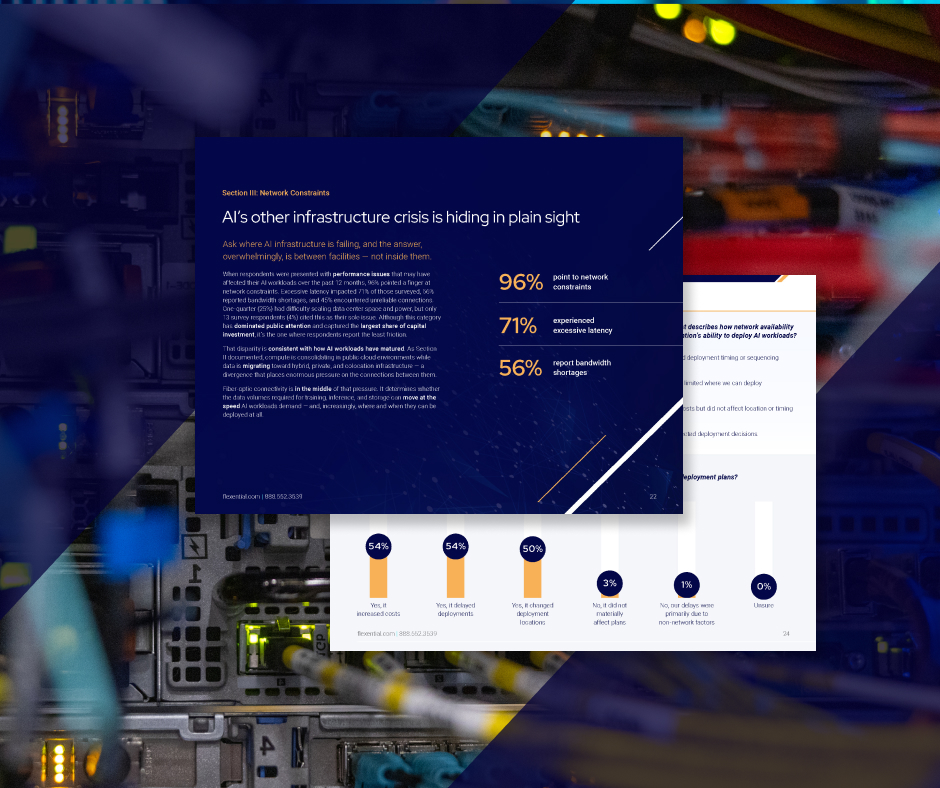
These challenges are compounded by existing infrastructure constraints. According to the 2026 State of AI Infrastructure Report, 96% of surveyed enterprise IT leaders experienced network-related performance issues affecting AI workloads. As AI environments become more distributed, organizations need to consider how connectivity and infrastructure dependencies affect operational reliability.
Flexential approaches production AI readiness through the combined disciplines of platform engineering, cybersecurity operations, data architecture, network engineering and resilience validation. This reflects a broader operational reality: reliable AI services depend on the infrastructure and processes supporting them, not solely on the performance of the AI models themselves. Organizations planning to scale agentic AI should evaluate these operational requirements alongside their deployment architecture, governance policies and business objectives.
Building confidence in autonomous operations
Agentic AI has the potential to change how enterprise IT teams work. Agents may help investigate problems, coordinate routine activities and respond to operational conditions faster than traditional processes allow. Those capabilities will become more useful as organizations gain experience managing them in production.
For infrastructure leaders, the immediate priority is understanding where autonomous actions introduce risk and whether existing operational controls are sufficient. That means knowing which agents are active, limiting their authority appropriately, monitoring their behavior and validating the organization's ability to respond when something goes wrong.
The organizations best positioned to expand agentic AI will be those that treat operational readiness as an ongoing responsibility, with governance, security and resilience built into how AI systems are deployed and managed.
For organizations still defining their approach, an AI strategy and roadmap can help align governance requirements, infrastructure readiness and operational responsibilities before AI adoption expands.