
The 100G era is here: Navigating hardware, optics, and AI hype
100G is more than a speed upgrade. It's a turning point in enterprise network planning. Tim Laughlin, Director of Interconnection Product Management at Flexential, shares practical insights into the technologies, lifecycle decisions, and AI trends driving the next decade of connectivity.

Recently, Flexential announced its initial support for 100G-LR access hand-offs across our core networking products, including IP Bandwidth and Data Center Interconnect (DCI) in four key markets as part of a long-term upgrade. This was, and is, a massive transition for Flexential. We embarked on a multi-year process to lifecycle our own fleet of backbone devices to support this offering, and all core links across the fleet now have a completed or road mapped plan to transition to a minimum speed of 400 Gbps.
The clients we speak with are excited about this increased throughput, with many viewing it as table stakes for the future. But this transition is also part of a much larger equipment and media lifecycle—one that will impact capital hardware expenditures for years to come. Form factors are shifting to the QSFP family, cables are retiring copper to consolidate around fiber, certain speeds have already emerged as the clear winners in the >10 Gbps standards battle, and the next era of technologies (800 Gbps and 1.6 Tbps) has already begun formalization and adoption.
These speeds will absolutely enable the next generation of workloads, but not entirely in the way most people think when they see buzzwords like “AI-enabled.” The networking architectures required to support ‘training within the cluster’ versus ‘getting data to and from the cluster’ are dramatically different.
Will knowing any of this make you cool at a cocktail party? No. You will be better served getting up to speed on the latest UAP disclosures or having a good talk track on why Cape Verde had such an incredible underdog run at the World Cup. But for those on the hook for IT costs, hardware, and roadmap planning, having these basics ingrained will help you press your network team during their next lifecycle planning session.
The SFP era
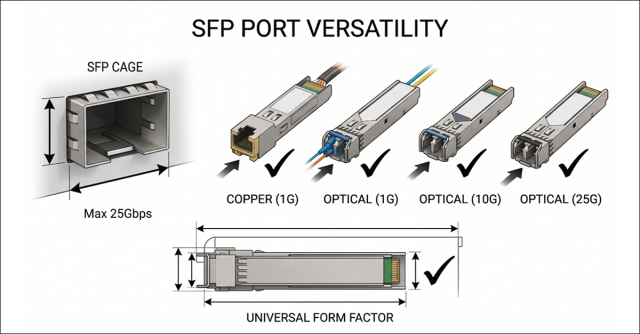
For most enterprises over the last decade, the largest port on their equipment was almost always an SFP+ (10 Gbps) or SFP28 (25 Gbps) capable slot. The magic of this era was that the SFP form factor could span both copper and fiber media types and address a huge swath of speeds from 1 Gbps to 25 Gbps. For many clients, that capacity growth represented more than a decade of IT lifecycle.
When you needed to upgrade a port speed, you just bought that little module—the Small Form-Factor Pluggable (SFP). You weren’t buying an entirely new switch or router.
Most importantly, these pluggables were relatively cheap. Changing from a 1 Gbps SFP to a 10 Gbps SFP was perhaps a $300 event in a worst-case scenario. An influx of third-party manufacturers helped keep the OEMs honest in this form factor. But, as we’ll see with the newer QSFP optics, “cheap optics” are no longer readily available for a variety of reasons.
You could ‘wing it’ in the SFP era. In the QSFP era, you need a highly deliberate plan for your speeds and media.
The QSFP form factor
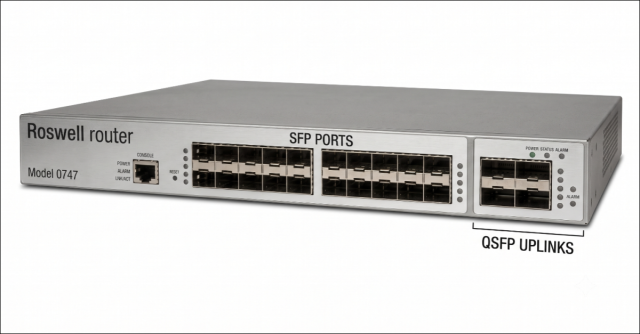
See the physical difference between the SFP ports on the left and the QSFP ports on the right? This is the new technology form factor that allows us to jump from the 1-25 Gbps tier up to 40-400 Gbps.
For most clients, QSFP ports are fairly common these days on true enterprise switching, but they are still not widely found on the retail and mid-tier firewalls we often see clients using at their network edge. We routinely see clients terminating WAN circuits on Palo Alto, Fortinet, Check Point, and Sophos firewalls. Unless you are buying the top-tier models, those devices are often SFP-only for their larger links. You simply cannot physically connect a 100 Gbps circuit to those boxes.
This form factor shift is exactly why your network team will likely need a capital hardware refresh to move into this next tier of speeds. Getting this right—in terms of both technology and timing—will have a critical impact on your hardware capital spending over the next decade.
Common speeds for QSFP
The QSFP family generally supports 40-400 Gbps. Within that range, acceptable media speeds are usually 40 Gbps, 100 Gbps, 200 Gbps, and 400 Gbps. I emphasize generally because of two factors:
- Engineers keep finding ways to cram more (or different) optical power into the existing footprint.
- The market feedback loop heavily selects for certain speeds. This means specific optical designs might be technically viable, but never end up widely adopted or further developed.
With that context, I’ll make an ‘All-UFOs-Are-Swamp-Gas’ level generalization: today’s QSFP interconnection market is entirely dominated by 100 Gbps and 400 Gbps.
For whatever reason, the industry did not broadly jump to the QSFP form factor just to achieve 40 Gbps; it simply wasn't enough of a capacity increase to justify the capital spend. It's a similar story with the newer PAM4 optical technology supporting 50 Gbps (SFP56) or 200 Gbps. Once the PAM4 100G-LR1 technology became available, it was a no-brainer to skip those lower tiers entirely.
An entire blog could be written about the underlying technology and market forces that shaped this standardization race, but I’ll save you the deep dive: 100G and 400G are the undisputed winners for the QSFP form factor.
In terms of the impact on you, this is exactly what you should expect when procuring interconnection. When you buy IP Transit from the big carriers, they are most likely going to hand you 100 Gbps or 400 Gbps. When you buy AWS Direct Connect On-Ramps, they will most likely require 100 Gbps or 400 Gbps hand-offs. We cannot make representations for major industry players’ public documentation, so I will just leave you with this recommendation: check their product documentation for interconnection. Almost all of them are going to require you to use 100 Gbps or 400 Gbps speeds on a QSFP-family form factor.
Costs in the QSFP era
Remember how you could wing it with SFP pluggables ten years ago? You can’t do that anymore. A couple of factors are at play:
- The optical technologies are vastly increasing in sophistication, heavily limiting the viability of generic third-party manufacturers.
- Many network OEMs are now strictly tying optics to their support plans, particularly when utilizing hyper-sensitive speeds like 400G in mission-critical deployments.
These factors are ultimately driving up both costs and operational importance. Some top-tier QSFP optics can reach $20,000 each.
Faced with this reality, service providers and consumers alike are forced to limit the hardware they support. If you try to support every single laser technology and speed in the QSFP form factor, you might end up needing to keep 16 different spare optics on-site just for backups. At current market costs, that is financially untenable, driving everyone to support as few standardized options as reasonably possible.
Media impacts of QSFP
Technically, you can use passive Direct Attach Copper (DAC) cabling for lower speeds like 40 Gbps over very short distances within the QSFP family. But once you hit the higher 100-400 Gbps speeds, the plausible distance for DAC drops to a brutal 1-3 meters. Are we really going to start designing expensive cages and cabinet layouts around those kinds of physical distance limitations?
Copper interconnection has been retiring across all kinds of niche environments for years. Flexential, alongside most major colocation providers, does not offer copper for any interconnection service above 1 Gbps, and many don’t offer copper services at all anymore.
One anecdote I like to share: Orange in France, BT in the UK, and several other regulatory bodies and companies across Europe have already issued formal retirement plans for their copper services. If you’re wondering if now is the time to migrate, I would press you to try and move faster than a European Telco! I say that in jest, but the reality is absolute: the world is permanently moving away from copper interconnection.
While this topic might seem more adjacent to capacity than directly impacted by it, in many of the projects we see, customers are utilizing this speed lifecycle as an opportunity to aggressively phase out legacy media. It is exceptionally difficult to operate dual media types as you transition into higher-capacity network equipment and form factors.
Use cases: QSFP, high speeds, and the AI networking buzz
You will inevitably hear about the next tier of networking speeds in the context of AI, particularly 800 Gbps and 1.6 Tbps. However, the technologies being used at these speeds for AI (specifically within AI training clusters) are largely irrelevant to everyday enterprise networking. Those backend technologies—namely InfiniBand or RoCEv2—rely on specific link technologies that aren’t utilized outside of GPUs talking directly to each other within a highly distance-limited cluster.
When you hear “AI 800 Gbps,” that simply isn’t the same transport technology being used to move data from San Francisco to Chicago. Only a very select few AI training companies are building that specific type of network.
Where high-capacity networking is highly relevant for the enterprise—and for the enterprise's AI use cases—is data ingestion and data residency.
For example, a bank or hospital has substantial customer or patient data they want to leverage for training with a third-party AI company, but they absolutely do not want that sensitive data having any sustained presence outside of their own secure platform. In this architecture, the bank or hospital would maintain 100 Gbps or 400 Gbps dedicated connectivity to the training platform, allowing the training data to be accessed or ingested seamlessly.
As more companies begin to view their proprietary data as their primary natural ‘moat’, consumers of AI training services will demand that their data sets are accessed only in limited, tightly controlled environments. High-capacity bandwidth is the only physical way to enable this architecture while remaining highly functional.
Beyond QSFP: A problem for the next decade
The reality for Enterprises today is firmly in the 100-400 Gbps range using the QSFP form factor. Very few have a true need for >400 Gbps networking right now.
But that hasn’t stopped AI companies and hyperscalers from fiercely pushing the limit! Today, 800 Gbps and 1.6 Tbps (yes, Terabits) are being deployed in AI training clusters. This extreme bandwidth forces the next hardware form factor: OSFP (Octal Small Form-factor Pluggable). OSFPs are wider, built to dissipate massive heat, and ultimately abandon native backward compatibility with your current gear.
Here is the business impact: OSFP is a 10-to-15-year horizon for the everyday Enterprise. It is coming, but it is at least 1-2 hardware lifecycles away. For the next decade of your capital planning, QSFP is the reality.
Takeaways for 100 Gbps, QSFP, hardware, and AI
The high-capacity era of Enterprise networking in the 100-400 Gbps range is incredibly exciting and enables all kinds of architectures, AI-driven and otherwise. However, it also comes with significant capital costs and hard lifecycle decisions that are critical to planning the next 5-10 years of your IT budget.
At the highest level, you should strongly consider standardizing on specific speeds, like 100 Gbps and 400 Gbps, and being highly strategic with your hardware lifecycle. Can you remove copper in the process? How can you consolidate to keep your QSFP transceiver costs down?
Thanks for reading! We are excited to be part of this journey at Flexential and to officially offer 100 Gbps services in our Phase I markets. Please reach out to your account rep if more details. We also provide Professional Services engagements for clients seeking a deeper partnership on their hardware migrations.

Tim Laughlin
Director of Interconnection Product Management